




Attraction
Fasano
A Puglian town between the Adriatic coast, ancient olive groves and the hills of the Valle d’Itria.
Attraction
A Puglian town between the Adriatic coast, ancient olive groves and the hills of the Valle d’Itria.
Attraction
A WWF-managed wetland reserve protecting coastal habitats and migratory birdlife near Lecce.
Attraction
A Salento city celebrated for exuberant limestone Baroque architecture and Roman remains.
Attraction
A whitewashed Valle d’Itria town known for stone courtyards, rural traditions and local cuisine.
Attraction
Puglia’s hilltop White City, a maze of limewashed lanes overlooking ancient olive groves.
Attraction
A Salento coastal town surrounded by sandy beaches and a protected marine environment.
Attraction
A protected Ionian landscape of pine forest, rocky paths and a clear-water bay.
Attraction
A scenic Ionian beach of rocky coves and clear water south of Gallipoli.
Attraction
A long stretch of pale sand and shallow Ionian water in northern Salento.
Attraction
A ceremonial coastal town at the southern tip of Salento, marked by a lighthouse and sea caves.
Attraction
A Calabrian mountain region of forests, lakes, plateaux and historic highland communities.
Attraction
A relaxed Adriatic seaside district with beaches, holiday homes and access to the Brindisi coast.
Attraction
A Salento village where Griko heritage and local Baroque architecture remain visible.
Attraction
A broad sandy beach on the Ionian coast within the Porto Cesareo area.
Attraction
A sequence of rocky coves and small beaches along Puglia’s Adriatic coast.
Attraction
A small Adriatic seaside village centred on beaches and a distinctive coastal watchtower.
The Florence of the South – Baroque Architecture, Salentine Cuisine and the Adriatic Coast
Lecce is one of southern Italy’s great surprises — a city of extraordinary baroque architecture built from the local golden limestone (pietra leccese), so abundant and so workable that the city’s 17th-century architects used it with an exuberance found nowhere else in Italy. The facades of the Basilica di Santa Croce, the Piazza del Duomo and the dozens of palazzi along the city’s pedestrianised streets are encrusted with a fantasy of carved saints, animals, flowers and grotesques that has earned Lecce its unofficial title: the Florence of the South.
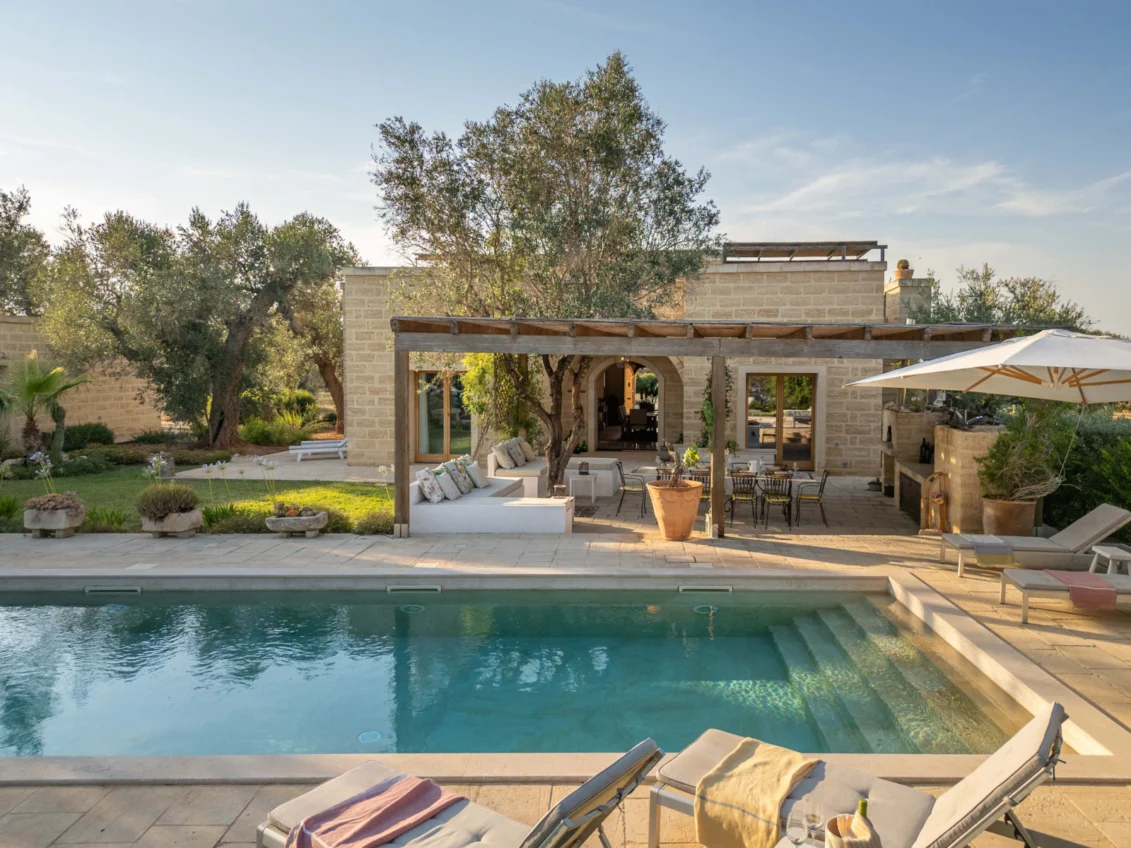
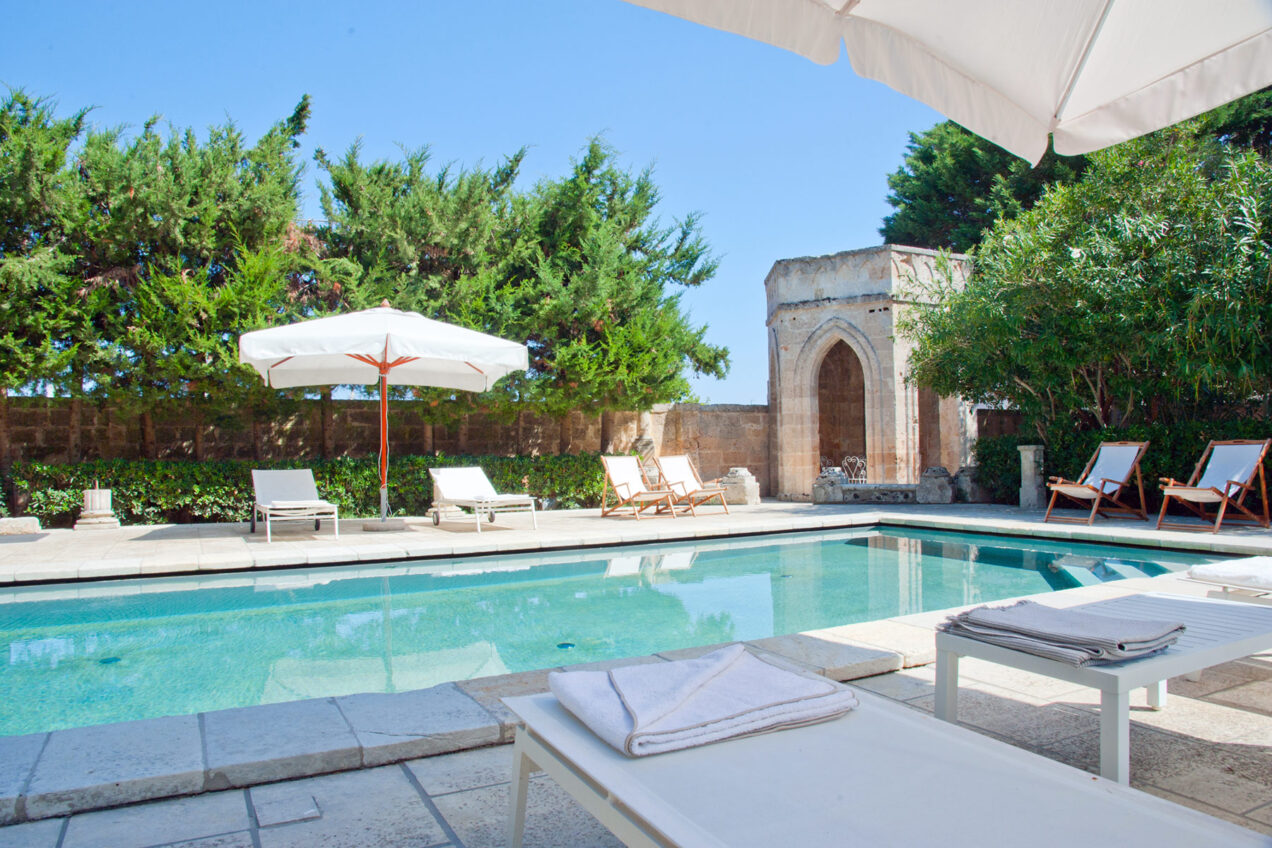
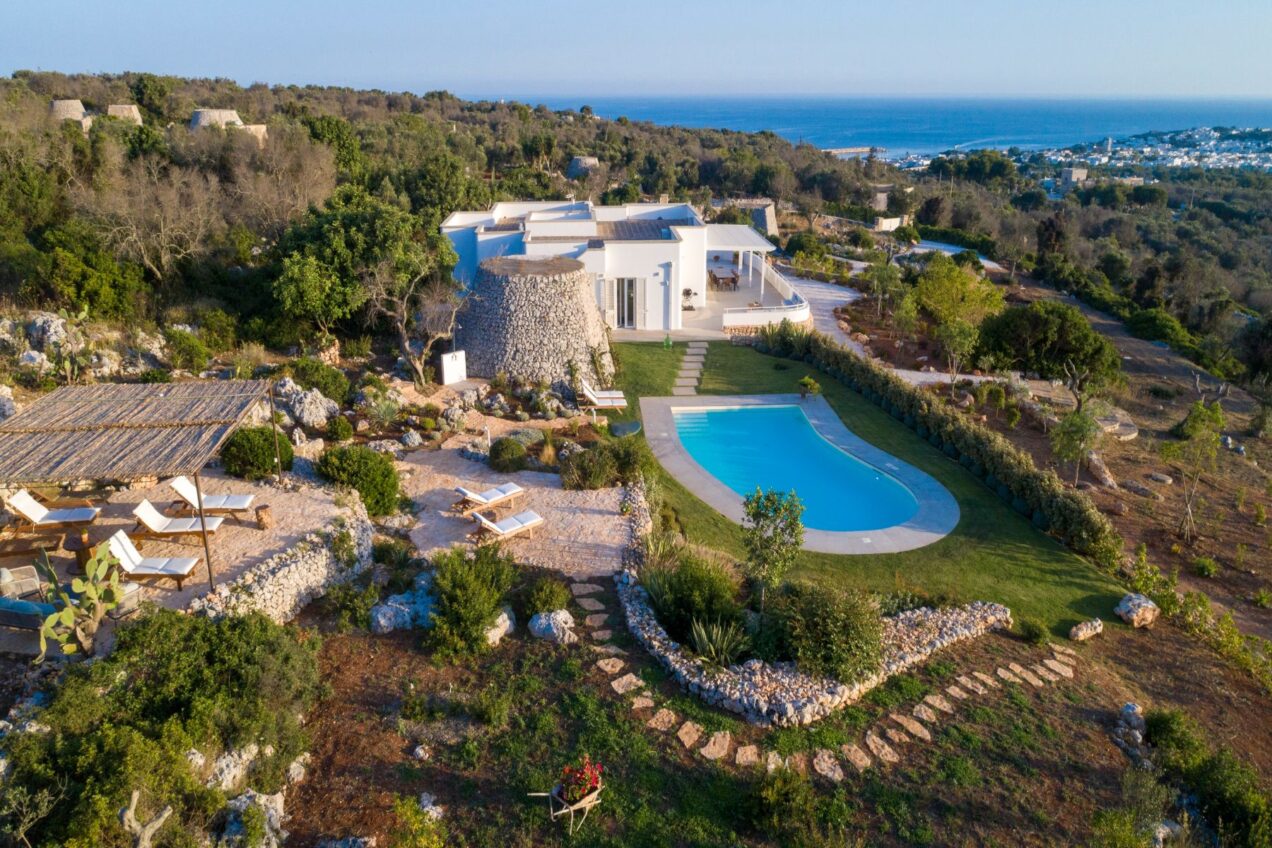
Beyond the architecture, the Salento — the long peninsula that forms the heel of Italy’s boot — offers some of the finest beaches in the Adriatic and Ionian seas, a rich gastronomic tradition built on olive oil, orecchiette pasta, frisella bread and the wines of the Primitivo and Negroamaro grapes, and a warmth and ease of living that makes it one of the most enjoyable parts of Italy for a slow, unhurried holiday. The villas in and around Lecce range from trulli-adjacent masserie in the olive grove countryside to seaside properties on the Adriatic coast, all within 30–45 minutes of the city centre.
Lecce and the Salento peninsula enjoy one of Italy’s most favourable climates — long, dry summers, mild winters, and a spring and autumn that extend the comfortable outdoor season well beyond what is possible in the north. The region is genuinely appealing in almost every month.
April & May — Outstanding
Spring arrives early in the Salento. By April the almond and wildflower season is already giving way to the full warmth of the southern Italian spring (18–23°C / 64–73°F). The countryside — flat, covered in ancient olive groves — is intensely green, the light is clear, and the beaches are empty. Lecce’s baroque streets and the surrounding masserie are at their most photogenic. The Adriatic sea temperature is still cool (15–17°C) but rising. Ideal for cultural visits, cycling, and walking.
June — Excellent
Early summer brings warm days (25–28°C), a sea that is warming toward 22°C, and the first beach visitors. The city is lively but not yet at peak. One of the best months for combining city visits with early beach days. The evenings are long and warm — outdoor dining at its finest.
July & August — Peak Beach Season
Very hot (30–35°C / 86–95°F) with the warmest sea (25–27°C). The Salento coast fills with Italian summer visitors, the masserie are at full capacity, and the beach clubs along the Adriatic and Ionian shores are in full swing. Lecce itself is less crowded than the coast — the city’s baroque core provides shade and the evenings bring cool breezes. A villa with a pool is essential. Book everything well in advance.
September & October — Superb
September is the finest month in the Salento: temperatures drop to 24–28°C, the sea remains warm (24–25°C), the crowds thin dramatically after the first week, and the food — the new season’s olive oil, the late-summer figs, the Primitivo grape harvest — is at its best. October is cooler (18–22°C) but often brilliantly clear and sunny. Strongly recommended.
November to March
Mild (10–15°C) and quiet. The trulli and masserie landscapes of the Salento look their most atmospheric in winter light. Some beach properties close, but Lecce itself is a year-round city. Villa rates are at their lowest.
| Month | Avg. Temp | Sea Temp | Crowds |
|---|---|---|---|
| April | 18°C / 64°F | 15°C | Very Low |
| May | 23°C / 73°F | 18°C | Low |
| June | 27°C / 81°F | 22°C | Medium |
| July | 31°C / 88°F | 25°C | High |
| August | 32°C / 90°F | 27°C | Very High |
| September | 27°C / 81°F | 25°C | Medium |
| October | 21°C / 70°F | 22°C | Low |
The Salento is one of Italy’s most car-dependent regions — the landscape is flat, the roads are good, and the distances between the coast, the city and the countryside require independent transport. This is also what gives it its unhurried character: no traffic jams, no coastal road congestion, no queues.
Getting to Lecce
Brindisi Airport (BDS) is the primary gateway — 40km north of Lecce, approximately 35–40 minutes by car. It handles direct flights from London Stansted, London Gatwick, Bristol, Edinburgh, Paris, Amsterdam, Brussels, Frankfurt and other European cities, with strong summer connections. Bari Airport (BRI) is 160km northwest (1 hour 40 minutes by car or 1 hour 30 minutes by direct train to Lecce) — it handles more routes year-round and is worth checking for off-season arrivals. A private transfer from Brindisi Airport to your villa is the most comfortable option; our concierge arranges this for all bookings.
Car Hire — Essential
For any villa stay in the Salento, a hire car is not negotiable — it is the single most important practical decision you will make. The masserie, the beaches, the baroque towns and the olive grove countryside are not served by public transport in any meaningful way. Pick up at Brindisi or Bari airport. Fuel costs are lower than northern Italy; toll roads are few on the Salento. A small or medium car is adequate — the roads are wide and flat.
Within Lecce City
Lecce’s baroque historic centre is almost entirely pedestrianised — one of the pleasures of the city is that you explore it entirely on foot, without traffic noise. Park at the perimeter car parks (free or low cost) and walk in. The city is compact; the Piazza del Duomo, Santa Croce, the amphitheatre and the main shopping streets are all within 15 minutes’ walk of each other.
Day Trips by Car
From a Lecce villa, you can reach: Otranto (40 minutes), Gallipoli (50 minutes), the baroque towns of Nardò and Galatina (20–30 minutes), the Grecia Salentina villages (30 minutes), the tip of the heel at Santa Maria di Leuca (1 hour), and the Adriatic beach towns of Torre dell’Orso and San Cataldo (20–30 minutes). Alberobello and the trulli country is 90 minutes northwest; Matera (Basilicata) is 2 hours.
Lecce rewards a slower pace than most Italian cities — it is a place to wander, to sit in a piazza with a pasticciotto and a caffè, to look up at the elaborately carved facades and wonder at the ambition of 17th-century southern Italian baroque. The surrounding Salento adds beaches, baroque towns and a landscape of ancient olives to the itinerary.
In Lecce
Basilica di Santa Croce
The definitive example of Lecce baroque — a facade so encrusted with carved decoration (roses, griffins, Turks, cherubs, saints) that the French writer Théophile Gautier once described it as “a giant’s delirious dream.” The interior is more restrained. The construction took over 150 years (1549–1695); the result is the most ornate church facade in Italy. Worth 30 minutes at minimum, longer if you study the iconography.
Piazza del Duomo
The enclosed baroque square — the Bishop’s Palace, the Seminary, and the Cathedral all in the same golden stone — is one of the most harmonious urban spaces in southern Italy. The Cathedral’s 68-metre bell tower is the dominant landmark of the Lecce skyline.
The Roman Amphitheatre
A 1st-century AD Roman amphitheatre discovered in the 1930s beneath Piazza Sant’Oronzo — the city’s central square. Much of it remains underground, but the excavated section (capacity around 25,000) gives a clear sense of the Roman city that preceded the baroque one. Free to view from street level; the adjacent museum has Roman finds from the site.
Museo Faggiano
One of Italy’s most unusual small museums: a private house whose owner began digging to repair a broken pipe in 2000 and found an unbroken sequence of occupation from Messapian through Roman, medieval and Renaissance periods beneath his floors. The excavation is now a fascinating layered museum — genuinely unmissable and little-known outside Italy.
Beyond Lecce
Otranto (40 minutes)
A walled port town on the Adriatic with a remarkable Norman–Byzantine cathedral mosaic floor (1163 AD) covering the entire nave — the largest medieval floor mosaic in the world, a cosmological vision of extraordinary complexity. The castle, the old Jewish quarter, and the Adriatic views from the walls complete the visit.
Gallipoli (50 minutes)
A baroque island city on the Ionian coast — the old town connected to the mainland by a 17th-century bridge, with a Greek fountain (the oldest in Italy), a good fish market, and beaches on both sides of the peninsula. The summer beach culture here is distinctively Salentine — relaxed, local, less commercial than the Adriatic side.
The Grecia Salentina Villages
A cluster of villages in the southern Salento where a Greek dialect (Griko) has been spoken continuously since antiquity — a living link to the Magna Graecia settlements of 2,500 years ago. Calimera, Martano and Sternatia have a quiet, authentic character and are within 30 minutes of Lecce.
The food of the Salento is Puglia at its most elemental — a cuisine built on the extraordinary quality of a few essential local products: the olive oil (the Salento produces more olive oil than the whole of Greece), the bread, the vegetables, the legumes, and the wine grapes of the Primitivo and Negroamaro varieties. It is not a complicated cuisine, but it is deeply satisfying and rooted in the land.
What to Eat
Orecchiette con cime di rapa — The signature pasta of Puglia: small ear-shaped pasta (orecchiette, made by hand by the women of Bari and the Salento) tossed with blanched turnip greens, anchovies, garlic and olive oil. Bitter, savoury, simple. The quality of the olive oil is everything — the Salento’s DOP oil, pressed from the ancient Ogliarola and Cellina di Nardò varieties, is among Italy’s finest.
Frisella — A twice-baked ring of durum wheat or barley bread, soaked briefly in water, rubbed with tomato, doused in olive oil and topped with whatever is seasonal — tomatoes, tuna, olives, capers, anchovies. The essential Salentine antipasto in summer; a perfect lunch eaten in the shade at a villa table.
Piselli e pasta — Dried peas (or broad beans) pureed and served with chicory and a thread of raw olive oil — the ancient peasant dish of the Salento, still eaten with pride. The combination of bitter greens and creamy legume puree is unexpectedly sophisticated.
Pasticciotto leccese — Lecce’s defining pastry: a small oval shortcrust case filled with crema pasticcera (custard cream), eaten warm for breakfast with a caffè leccese (espresso poured over almond milk and crushed ice). Both the pasticciotto and the caffè leccese are experiences worth making a detour for. The bar Alvino in Piazza Sant’Oronzo is the historic address.
Pittule — Small fried dough balls made from a basic bread dough, eaten hot from the fryer with a glass of local wine — the traditional Salentine street snack, particularly around Christmas but available year-round in good trattatorie.
The Wines of the Salento
Primitivo di Manduria DOC/DOCG — The Primitivo grape (genetically identical to California’s Zinfandel) produces deep, rich, high-alcohol reds from the flat plains north of Lecce. At its best — from producers like Gianfranco Fino, Pervini or Feudi di San Marzano — it is a genuinely serious wine with dark fruit, dried fig and spice notes. The Primitivo di Manduria Dolce Naturale DOCG (a sweet version) is exceptional with strong cheeses.
Salice Salentino DOC — A Negroamaro-based red from the zone around Lecce, aged for a minimum period that gives it structure and depth. A more elegant and food-friendly expression of the local Negroamaro grape than the rich Primitivo. Producers: Leone de Castris (the historic address), Cosimo Taurino, Cantele.
Verdeca and Fiano Minutolo — Two native white grapes of the Salento producing aromatic, floral whites that work beautifully with the local seafood. Fiano Minutolo in particular has a distinctive muscat-like aroma unique to this corner of Puglia.
The Olive Oil
The Salento is carpeted in ancient olive trees, some of them over 2,000 years old and now protected by UNESCO. The local DOP oil — Terra d’Otranto — is produced from the Ogliarola Salentina, Cellina di Nardò and Leccino varieties and pressed fresh from October. If visiting in autumn, seek out olio nuovo from a local frantoio — one of the great simple pleasures of a Salento stay.
Is Lecce worth visiting beyond its baroque architecture?
Yes — very much so. The Salento’s beaches, baroque towns (Otranto, Gallipoli, Nardò), ancient Greek heritage (Grecia Salentina villages, Messapian ruins), outstanding food and wine culture, and the distinctive masseria villa experience all make the area one of Italy’s most rewarding for a full week’s stay. The architecture is the calling card; the quality of living here is the reason to return.
Do I need a car in the Salento?
Yes, without exception. The landscape is flat and the roads are good, but the masserie, beaches and most interesting villages are not served by public transport. A hire car from Brindisi or Bari airport is essential. The positive side: the Salento has none of the driving stress of the Amalfi Coast — wide roads, light traffic, easy parking.
Which airport is closer to Lecce — Brindisi or Bari?
Brindisi (BDS) is 40km from Lecce (35–40 minutes by car) and is the more convenient arrival point. Bari (BRI) is 160km away (1 hour 40 minutes) but handles significantly more routes, particularly outside the summer peak. For guests flying from the US, connecting through Rome or Milan to either Brindisi or Bari is the standard routing.
What are the best beaches near Lecce?
The Salento has excellent beaches on both coasts. On the Adriatic (east) side: Torre dell’Orso, San Cataldo and Otranto are the most popular — sandy beaches with clear water. On the Ionian (west) side: Gallipoli’s beaches and the Santa Maria di Leuca area are finer-grained and often calmer. The rocky coves of the Costa dei Trabocchi are more scenic but less suited to families with young children. All are 20–60 minutes from a Lecce villa.
Is Lecce suitable for a July or August villa holiday despite the heat?
Yes, with appropriate expectations. Temperatures of 30–34°C in peak summer are manageable with a villa pool, the shade of the old town’s baroque streets, and the sea within 30–40 minutes. The Salento’s flat terrain and sea breezes make the heat more tolerable than in enclosed inland valleys. The beach and villa rhythm of afternoon pool, evening city, morning sea works very well here.
Can we do a day trip to Matera from a Lecce villa?
Yes — Matera (Basilicata), famous for its prehistoric sassi cave dwellings and now a UNESCO World Heritage site, is approximately 2 hours from Lecce by car. It makes an excellent full-day excursion. Alberobello and the trulli zone is 90 minutes northwest and also worth a day trip — though many guests find that the masseria landscape around Lecce itself is more authentically rewarding than the tourist-heavy trulli village.
Get in touch with us. Tell us dates, guests, and style — we’ll help you find the most suitable villas for your trip to Lecce.
Ask our concierge