Salento Luxury Villas For Rent



Salento
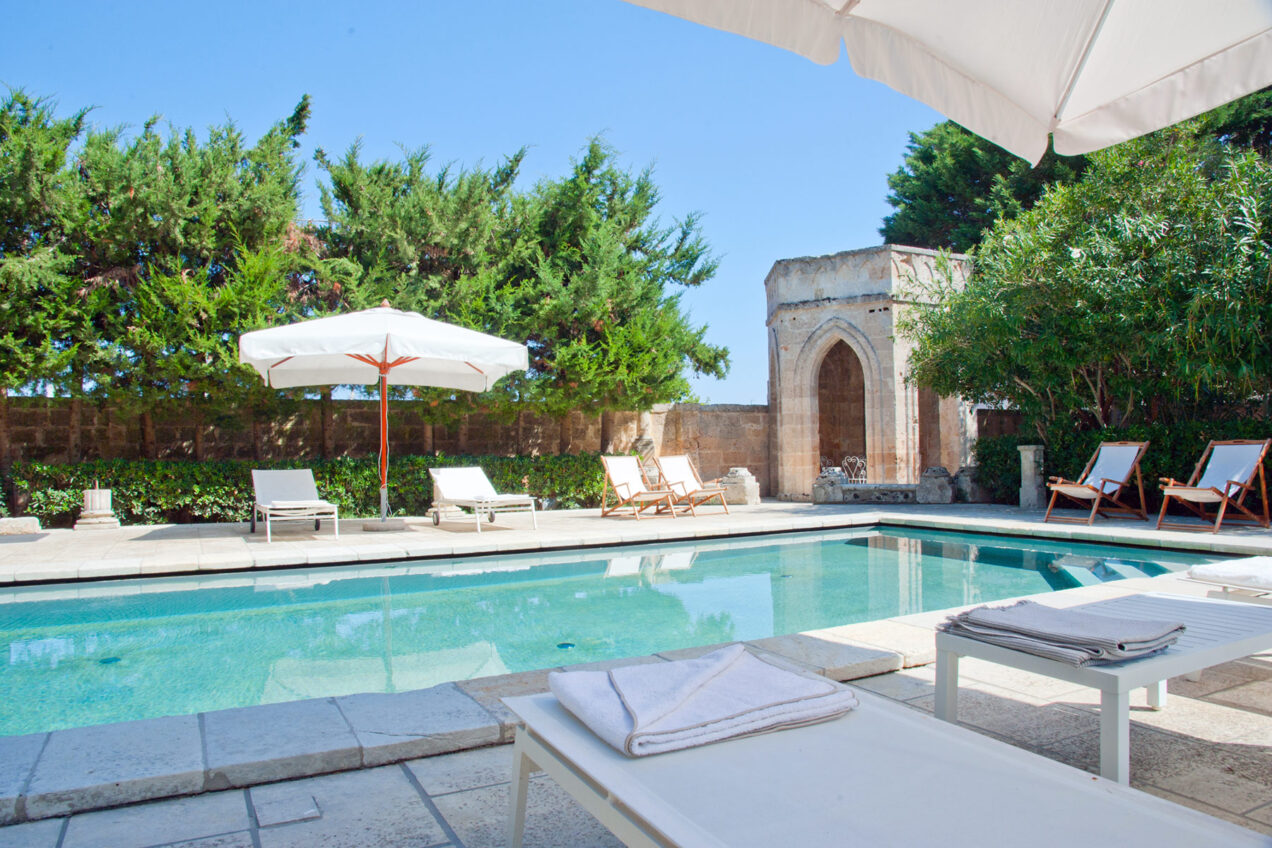
The sun-bleached heel of Italy — where Baroque Lecce meets crystalline Ionian and Adriatic seas, and whitewashed masserie sit in centuries-old olive groves.
The Salento is the southernmost tip of Puglia and of mainland Italy — a flat, sun-drenched peninsula between two seas where the light has an intensity that painters and photographers have sought for centuries. Lecce, its baroque capital, is one of the most architecturally extraordinary cities in the south: an entire historic centre built in golden limestone and covered with exuberant carving, earning the city its nickname of the Florence of the South. Beyond the city, the Salento landscape is one of ancient olive trees (some over a thousand years old), dry-stone walls, white-roofed masserie and coastal watchtowers from the Turkish era looking out over seas of Adriatic blue and Ionian turquoise.
Villa guests in the Salento are typically drawn by the combination of exceptional beaches — the bays at Torre dell’Orso, Santa Maria di Leuca, Porto Selvaggio and Otranto rank among the finest on the Italian peninsula — and the living Baroque culture of Lecce and the surrounding towns. The Salento also has one of the strongest musical and folk traditions in the south: the pizzica, a frantic ritual dance linked to the tarantula myth, is performed at festivals throughout the summer and is a genuinely extraordinary spectacle. This is southern Italy at its most confident and most itself.
The Salento has one of the most reliably sunny climates in Italy — over 300 days of sun per year — and is genuinely pleasant for most of the year. The finest period for combining sea and culture is late May through June and September. In late spring, the sea is warming up (21–23 °C), the Baroque towns are not yet crowded, the surrounding countryside is green with wildflowers, and the light is extraordinary. June allows evening swims in warm water with long summer sunsets over the Ionian Sea.
July and August are peak season: the beaches are animated, every restaurant is open and the summer festivals — including the La Notte della Taranta festival at Melpignano in late August (one of the largest music festivals in Europe, dedicated to the pizzica tradition) — make this the most socially alive period. The heat (34–38 °C) is real but the sea breeze moderates it on the coast. September is many guests’ favourite month: the sea is at its warmest (27–28 °C), the crowds thin after Ferragosto, restaurants are at their best and the landscape takes on a warm amber light. October and November are mild, ideal for cultural exploration of Lecce and the inland Baroque towns without competition from other visitors.
Brindisi (BDS) is the primary gateway for the Salento, with direct connections from most major European cities and from Rome and Milan. Transfer time to Lecce is about 30–40 minutes; to the southern Salento coast (Santa Maria di Leuca, Gallipoli), allow 60–90 minutes. Bari (BRI) to the north (about 150 km) offers more international flight options and is viable for guests who don’t mind a 90-minute transfer, ideally with a scenic coastal stop. A private chauffeur from Brindisi airport, arriving via the SS16 with views of the Adriatic opening to the east, makes an excellent arrival.
The Salento is compact enough to explore thoroughly by car in a week — the entire peninsula from Brindisi to Santa Maria di Leuca is about 100 km. The roads are generally good and traffic is light outside peak summer weekends. Lecce is best explored on foot once parked outside the historic centre; the pedestrian zone and the density of Baroque monuments within a walkable area make it one of the most rewarding city-walking experiences in the south. For guests based on the coast, water taxis and boat hire are available from most harbour towns for excursions to caves, sea stacks and remote coves accessible only by sea.
Lecce is the unmissable starting point — its Baroque architecture in golden pietra leccese (a workable limestone unique to the area) is among the finest in Europe. The Basilica di Santa Croce, with its extraordinary facade of carved stone vines, sea monsters and putti, took 150 years to complete; the Piazza del Duomo and the Roman amphitheatre in the centre of the city are equally exceptional. Allow a full day; the city rewards slow exploration with constant discoveries of carved doorways, courtyard gardens and artisan workshops where papier-mâché figures (a centuries-old local craft) are still produced by hand.
The Salento coast offers two distinct seas. The Adriatic coast to the east (Torre dell’Orso, Otranto, Castro) has rocky limestone coastlines with sea caves, crystal-clear water and dramatic cliffs; the walled town of Otranto with its mosaic-floored cathedral floor and the Aragonese castle is one of the most atmospheric in the south. The Ionian coast to the west (Gallipoli, Torre San Giovanni, Santa Maria di Leuca) has gentler water, sandy beaches and a more developed resort infrastructure. Gallipoli — a Baroque island town connected to the mainland by a bridge — is one of the most beautiful small cities in Puglia. The Porto Selvaggio natural reserve between Gallipoli and Lecce is a protected pine forest above a rocky Ionian coast with no development, ideal for walking and swimming.
Salento food is among the most distinctive in Puglia. Rustico leccese — a warm pastry parcel of béchamel, tomato and mozzarella — is the iconic street food of Lecce, available from bakeries throughout the city. Pittule (fried dough fritters with various fillings), sagne ‘ncannulate (wide twisted pasta with tomato and ricotta), and the extraordinary range of local vegetables — wild chicory, friggitelli peppers, lampascioni, cime di rapa — define the cucina povera of the peninsula. Fish on the Ionian coast is excellent: grilled sea bream, raw sea urchins, octopus salad with lemon and wild fennel.
The Salento has experienced a remarkable wine revolution. Primitivo di Manduria DOC — a rich, sun-concentrated red from the Primitivo grape (genetically identical to California’s Zinfandel) — is the area’s most famous wine, best from producers such as Gianfranco Fino and Pervini. Negroamaro, the other great Pugliese grape, produces the earthy, powerful Salice Salentino DOC and the Copertino, Squinzano and Leverano appellations — complex reds with excellent ageing potential. White wines from Verdeca and Fiano are improving rapidly. Local extra virgin olive oil from the ancient Ogliarola trees — some of the world’s oldest cultivated olives — is superb; several masserie press their own oil in November and share it with villa guests.
Which coast is better — Adriatic or Ionian?
They offer genuinely different experiences. The Adriatic coast (Otranto, Castro, Torre dell’Orso) is more dramatic — rocky cliffs, sea caves, crystal-clear water in intense blues and greens, and a wilder atmosphere. The Ionian coast (Gallipoli, Torre San Giovanni, Pescoluse) has gentler, warmer water, longer sandy beaches and a more developed resort infrastructure. Many guests stay in the centre of the peninsula and use both coasts on alternating days — the drive from one sea to the other is just 25–30 minutes.
What is La Notte della Taranta and is it worth attending?
La Notte della Taranta is a week-long festival of pizzica music and dance held in late August across several towns in the Salento, culminating in a massive concert at Melpignano attended by 100,000+ people. It is one of the most remarkable folk music events in Europe — authentic, joyful and genuinely extraordinary as a spectacle. Booking villa accommodation for this period requires advance notice of several months.
How far is the Salento from the Valle d’Itria and Alberobello?
Lecce is approximately 100 km from Alberobello (about 80 minutes by car) and 80 km from Martina Franca. A split stay combining a Valle d’Itria masseria with a Salento coastal villa is one of the most popular Puglia itineraries — we regularly arrange properties for both parts of the stay with seamless transitions.
Need help choosing?
Get in touch with us. Tell us dates, guests, and style — we’ll help you find and the most suitable villas for your trip to Salento.
Ask our concierge