
Attraction
Asolo
A graceful Veneto hill town associated with art, theatre and panoramic views.
Attraction
A graceful Veneto hill town associated with art, theatre and panoramic views.
Attraction
An Alpine lake of elegant waterfront towns, gardens and the Borromean Islands.
Attraction
A historic golf course in the wooded hills above Lake Como.
Lombardy’s Underestimated City – Roman Ruins, a Renaissance Piazza and the Eastern Shore of Lake Garda at the Door
Brescia occupies a position in the Italian luxury travel conversation that is disproportionately modest relative to its actual quality. A Roman capital of the first order – the Capitolium temple, the theatre and the extraordinary Winged Victory bronze (among the finest Roman sculptures in existence) remain in situ in the heart of the city – it also possesses a UNESCO-listed Renaissance piazza, a Lombard castle on the hill above and a historic centre that functions with the full commercial and cultural vitality of a prosperous northern Italian city. It is reached in 50 minutes from Milan by high-speed rail and sits 25 km from the eastern shore of Lake Garda, giving it a dual identity as both a self-sufficient cultural destination and the most practical base for guests whose itinerary combines city culture with lakeside Villa life.
For guests renting a luxury villa in the Brescia area, the surrounding landscape delivers the full range of the northern Italian experience: Lake Garda’s olive groves and thermal resorts to the west, the Franciacorta wine hills immediately south (one of Italy’s finest sparkling wine zones, now attracting serious international wine attention), the Lombardy Alps beginning at Brescia’s northern boundary with ski resorts and Alpine lakes accessible in under an hour. The villa acts as a private base from which to range across one of the most concentrated accumulations of landscape, cuisine, wine and culture in the country – without the hotel lobby or the tour group that compromises the experience elsewhere.
Brescia operates on the northern Italian seasonal calendar rather than the Mediterranean one: spring and autumn are the finest periods for the city itself and for the cultural itinerary of the surrounding area, while summer channels energy toward Lake Garda and the Alpine foothills. Understanding this seasonal distribution allows guests to calibrate expectations between urban and landscape experience.
April through June is when Brescia and the surrounding area are at their most balanced: mild temperatures (18–24°C), the Franciacorta wine hills at their most intensely green, Lake Garda’s olive groves beginning to flower, and the city’s museums and monuments fully operational without the summer concentration of visitors. The Mille Miglia – one of the world’s most celebrated historic motor races, departing and arriving in Brescia in mid-May – is a cultural event of genuine importance for automotive enthusiasts; the cars assemble in Piazza della Vittoria the evening before departure, creating one of the most extraordinary automotive spectacles in Italy. Booking accommodation and villa properties for the Mille Miglia weekend requires 6+ months of advance planning.
In summer, the gravitational centre of the Brescia experience shifts decisively toward Lake Garda: the eastern shore (Sirmione, Desenzano del Garda, Salò, Gargnano) becomes the primary destination for villa guests and the city itself quietens to a pleasant working-town pace. The lake is at swimming temperature from mid-June through September (22–24°C peak); the sailing season on Garda is among the most active in Europe, driven by the thermal winds (Ora and Pelèr) that make it a world-class sailing lake. Brescia city in July and August is genuinely uncrowded by tourist standards – many of its residents have moved to lake or mountain houses – making it an excellent time for the Roman sites and the Pinacoteca Tosio Martinengo without queues.
September and October are the most rewarding months for the full Brescia area experience. The Franciacorta harvest typically runs from late August through September; the Garda Classico DOC (olive oil and wine) harvest begins in October. The Franciacorta wine festival (held in September in Erbusco) concentrates most of the major producers for a public tasting event of high quality; individual estate visits are easiest to arrange in September and October when the harvest pace eases. The autumn light over Lake Garda – amber and low-angled over the southern lake – is at its most painterly in October. The city’s cultural programme extends through autumn with museum exhibitions and the theatre season beginning in October.
The Lombardy ski resorts begin with the Alpine valleys north of Brescia (Valle Camonica, Tonale Pass) and extend to the more developed areas of Livigno and Ponte di Legno accessible in under 2 hours. For villa guests combining city and skiing, Brescia in January and February provides a warm-weather base (by Alpine standards) with quick ski access. The city’s Christmas market and its New Year concert programme in the Piazza della Loggia attract significant domestic visitors; the Mille Miglia museum and the Roman sites maintain their full programmes year-round.
Brescia is one of the best-connected second-tier Italian cities: the high-speed rail line places it 50 minutes from Milan and 25 minutes from Verona; the A4 Autostrada (Milan–Venice) passes through the city; and the Brescia Montichiari airport handles charter and low-cost traffic. For guests arriving from major international hubs, Brescia represents a genuinely accessible destination without the Milan or Venice airport chaos.
Brescia Montichiari Airport (VBS) is a secondary airport 20 km south of the city, handling seasonal low-cost routes from a limited range of European cities. For most international arrivals, the preferred gateways are Milan Malpensa (MXP, 1 hour by road or rail) and Milan Linate (LIN, 1 hour by road), with Verona Catullo (VRN, 30 minutes by road) providing an eastern alternative for guests connecting from international flights via Rome, Frankfurt, Amsterdam or London. Bergamo Orio al Serio (BGY, 40 minutes by road) handles the full Ryanair network from most European cities and is a surprisingly efficient and uncrowded airport for the volume of traffic it processes. Private aviation clients typically use Brescia Montichiari or Verona for business-jet operations; both have FBO services of adequate standard.
Brescia station is on the Milan–Venice high-speed line. Frecciarossa and Frecciargento services from Milan Centrale take 48–55 minutes; from Verona Porta Nuova approximately 25 minutes; from Venice Santa Lucia approximately 1 hour 15 minutes; from Rome Termini approximately 2 hours 40 minutes (changing at Milan). The station is centrally located; the historic centre is a 15-minute walk or a short taxi ride. For guests arriving at Milan Malpensa, the direct Malpensa Express to Milan Centrale followed by high-speed connection to Brescia is efficient and requires minimal time in the city. Brescia’s metro (two lines) connects the station to the city centre and to the cable car terminal for Colle Cidneo.
From Milan: A4 east to Brescia – approximately 1 hour in normal traffic. From Verona: A4 west – approximately 35 minutes. From Venice: A4 west – approximately 1 hour 30 minutes. From Lake Garda eastern shore: SS11 or SS572 – 25–35 minutes. The Brescia bypass (Tangenziale di Brescia) provides efficient north-south movement without entering the city centre; villa properties north of the city in the Franciacorta hills or east toward the Garda shore are typically 15–25 minutes from the motorway. The ZTL in the historic centre restricts private vehicle access; most villa guests park outside the restricted zone and use public transport or taxis for city visits.
Brescia’s metro system (Line 1 and Line 2) provides efficient movement within the city. For the surrounding area – Franciacorta wine estates, Lake Garda eastern shore, the Valle Sabbia and Valle Camonica Alpine valleys – a private vehicle is essential. The Lake Garda ferry service (Navigazione Lago di Garda) connects the main lakeside towns from Desenzano to Riva del Garda; a car ferry crosses between Maderno (east shore, 45 minutes from Brescia) and Torri del Benaco (west shore). For guests who prefer not to drive, the regional train service from Brescia to Desenzano del Garda takes 20 minutes; private transfer to the lakeside is the most comfortable option for daily excursions.
Brescia’s cultural offer is structured around one of the finest concentrations of Roman remains north of Rome, a medieval and Renaissance civic centre of genuine ambition, and a surrounding landscape that shifts between Lake Garda’s Mediterranean microclimate, the wine hills of Franciacorta and the Alpine valleys of the northern province – all within a 60-km radius that can be fully explored in a week’s stay.
The Roman Brescia (Brixia) archaeological complex – the Capitolium temple, the Roman theatre, the remains of the forum and the domus mosaics – is among the most intact and accessible Roman urban sites in northern Italy. The Capitolium, a three-cella temple of the Flavian period (73 CE), still stands to near-full height; the adjacent theatre accommodated 15,000 spectators. The Museo di Santa Giulia, the primary civic museum housed in the former Benedictine monastery of Santa Giulia (itself a UNESCO site), contains the Winged Victory of Brescia – a first-century BCE bronze statue of extraordinary refinement that was reused in the Roman period as a trophy figure – alongside Roman portrait bronzes, early Christian ivories and the Desiderius Cross, a Lombard royal reliquary cross of the 8th century that is among the most important objects of the early medieval period in existence. Allow at least half a day for the museum complex.
Brescia’s Renaissance centrepiece is the Piazza della Loggia, dominated by the Loggia (the Palazzo Comunale, begun in 1492 with contributions from Sansovino and Palladio) and the Orologio astronomico tower of 1546. The adjacent Piazza del Duomo holds both the Romanesque Duomo Vecchio (a circular construction of the 12th century, one of the finest Romanesque buildings in Lombardy) and the Baroque Duomo Nuovo (17th century). The Pinacoteca Tosio Martinengo, recently renovated, houses the Brescia school of Renaissance painting, including the extraordinary portraits of Alessandro Bonvicino (called Moretto) and Giovanni Gerolamo Savoldo – artists of European quality whose reputations remain unjustly confined to specialist circles.
The eastern shore of Lake Garda – the Brescian shore, technically – is the most varied section of the lake. Sirmione, on its peninsula at the southern end, combines a Scaligero castle, the Roman Villa of Catullus (a vast lakeside complex of the 1st century BCE) and thermal spa infrastructure (Terme di Sirmione) with a tourist density in peak season that requires early morning or late evening visits to enjoy on its own terms. Moving north, Desenzano del Garda is the most lively commercial town; Salò (the involuntary capital of the Italian Social Republic in 1943–45) has a cathedral with the finest collection of Brescian painting in the Garda area; Gargnano, at the narrowing of the lake, is the insider choice for its physical beauty, its historic lemon houses (limonaie) and the Villa Feltrinelli, which functions as one of Italy’s finest luxury hotels.
The Franciacorta DOCG – for metodo classico sparkling wines produced from Chardonnay, Pinot Nero and Pinot Bianco in the moraine hills immediately south of Brescia – has evolved in 30 years from a regional speciality to a wine with genuine international standing. The leading estates (Bellavista, Ca’ del Bosco, Contadi Castaldi, Berlucchi, Guido Berlucchi) operate serious visitor programmes; Ca’ del Bosco in particular maintains an estate that combines the winery with a sculpture park and a restaurant (Il Convento) of serious ambition. A half-day Franciacorta estate tour with private guide, lunch at the estate restaurant, and a cellar purchase to stock the villa is a natural day-two activity for serious wine guests.
Brescia’s cuisine is Lombard in its foundations – casoncei (pasta stuffed with cheese, breadcrumbs and salami), spiedo bresciano (a slow-roasted mixed spit of meats cooked over wood embers for 6–8 hours, served on Sundays at every serious local trattoria), lake fish from Garda and Iseo, polenta in multiple forms – combined with the sophistication that a prosperous northern Italian city invariably generates in its restaurant sector. The wine context is exceptional: Franciacorta for sparkling, Lugana DOC (Turbiana/Trebbiano di Lugana, a fine white from the southern Garda shore) for whites, and the underrated Botticino and Cellatica DOC reds for the local red context.
The spiedo bresciano is among the most distinctive traditional preparations in Lombardy: a wooden spit loaded with alternating pieces of chicken, pork loin, beef, spare ribs, small birds (traditionally sparrows, now more commonly quail), potatoes and sage, turning slowly over a wood fire for 6–8 hours while basted continuously with the dripping fat collected below. The result has a flavour and texture that no oven roasting approximates; serious bresciani consider it the defining preparation of their food culture, made at home on Sundays with a spit apparatus that is a standard household possession. Several restaurants in the city offer it as a daily speciality; the weekly markets at the surrounding towns frequently have spiedo producers selling by the portion. For villa guests, a spiedo lunch catered by a local specialist is one of the most authentic Lombard hospitality gestures possible.
La Sosta, on Via San Martino della Battaglia, has maintained a serious standard for traditional Brescian cooking for decades and is the reference table for the city’s culinary establishment: casoncei, spiedo, lake fish and a cellar focused on Franciacorta and Lugana. Trattoria Mezzeria (Vicolo del Prezzemolo) is more informal and locally oriented, with daily market-driven specials and a clientele that skews toward the Brescia professional class. For fine dining with a more contemporary sensibility, Ristorante Feeling (Via Musei) occupies a space in the Roman excavation zone and serves a tasting menu that draws on Lombard ingredients through a modern Italian lens. Lake Garda adds several reference tables to the equation: Villa Feltrinelli at Gargnano (two Michelin stars) is the summit of the regional dining scene; La Tortuga at Gargnano (one star) operates at equally serious level; Esplanade at Desenzano del Garda provides the lakefront luxury experience.
A villa stay in the Brescia area should be accompanied by a wine programme built around the two great local denominazioni. Franciacorta DOCG non-vintage Brut, Satèn (blanc de blancs in a softer style) and Rosé provide the aperitivo and first-course framework; the vintage Franciacorta from Ca’ del Bosco or Bellavista is a match for any Champagne in the same price bracket for serious wine guests. Lugana DOC – produced from the Turbiana grape in the southern Garda moraine – is one of Italy’s most ageworthy whites: a serious Lugana Superiore or Riserva from Zenato, Ca’ dei Frati or Ottella will repay 5–10 years of cellaring and is extraordinary with lake fish. Villa management can source directly from the Franciacorta and Lugana estates for cellar provisioning; several estates offer private cellar dinners that can be arranged for groups of 6–12 guests.
The Mille Miglia (literally “Thousand Miles”) is the world’s most celebrated historic motor race, run as a regularità (time-speed-distance) rally rather than a competitive race since its revival in 1977. The route of approximately 1,600 km connects Brescia, Rome and back, covering some of the most beautiful roads in central Italy. The cars – all pre-1957 vehicles that participated in the original 1927–1957 Mille Miglia race – assemble in Brescia’s Piazza della Vittoria the evening before departure and return to Brescia for the prize-giving 3–4 days later. The event typically takes place in mid-May; exact dates vary year to year. For automotive enthusiasts, the assembly evening in Brescia – with perhaps 400 rare and historically significant cars parked on the piazza while their crews prepare for the following morning’s start – is one of the most extraordinary free spectacles in Italy. Villa properties with good access to the A1 route (the race passes through Tuscany and Umbria en route to Rome) provide opportunities to observe the cars on road sections as well.
The eastern shore of Lake Garda begins approximately 25 km west of Brescia. Desenzano del Garda is 30 minutes by car; Sirmione 35 minutes; Salò 45 minutes; Gargnano 1 hour. The Brescia–Desenzano train takes 20 minutes. For villa guests using Brescia as a base for Lake Garda exploration, the eastern shore is the Brescia shore and provides easy access to all major lakeside towns without crossing to the Trentino or Veneto sides, which require either the ferry crossing or a 1-hour road circuit via the southern lake towns.
Franciacorta DOCG is Italy’s most serious metodo classico sparkling wine, produced from Chardonnay, Pinot Nero and Pinot Bianco in the moraine hills south of Lake Iseo, 20 km from Brescia. Like Champagne, it undergoes secondary fermentation in the bottle with extended ageing on the lees; unlike Champagne, it is produced in a warmer climate that gives the wines a rounder, more generous fruit character. The top producers – Ca’ del Bosco Cuvée Prestige, Bellavista Alma Gran Cuvée – consistently outperform comparable price-point Champagnes in blind tastings among Italian and European sommeliers. It remains significantly underpriced relative to Champagne and represents exceptional value for guests who discover it at source. The Franciacorta wine road connects all major estates in a circuit of approximately 30 km from Brescia.
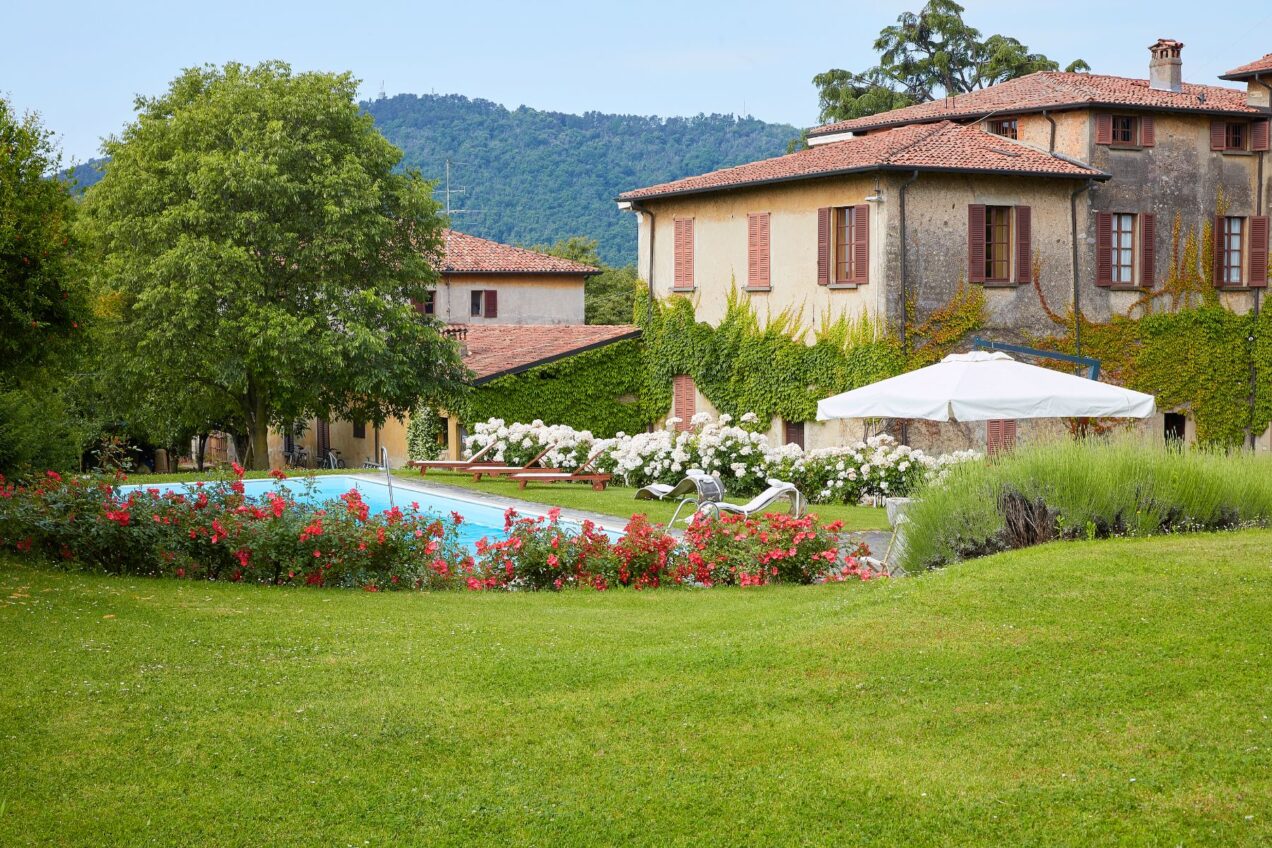
SopranoVillas’ Brescia area properties are positioned primarily in the Franciacorta hills and on the eastern Lake Garda shore, combining landscape quality with rapid access to both the city and the lake. Properties range from contemporary Lombard farmhouse conversions in the Franciacorta vineyards to lakeside villas with private dock access on the Garda eastern shore. The area is particularly well-suited to guests whose itinerary combines cultural visits (Brescia Roman heritage, the Bergamo Città Alta, Verona Arena) with wine-focused estate visits and lake or Alpine activity. We recommend booking 3–4 months in advance for spring stays and the Mille Miglia period, and 6 months ahead for peak Lake Garda summer weeks in July and August.
Get in touch with us. Tell us dates, guests, and style — we’ll help you find the most suitable villas for your trip to Brescia.
Ask our concierge